Mahabharata- My notes and why I made them
Mahabharata, in my opinion, is one of the most unique*6 and complex*5 stories with encyclopaedic aspects*1, kaleidoscopic contexts*2 and telescopic visionaries*3 where microscopic details*4 need to be noted to not to miss the nuances which may be too vital part of the plot.
Mahabharatalays everything in open. It portrays too many characters, their attitudes and actions involving lots of plots, hordes of substories within stories, multitude of events good, great, excellent, bad , ugly and many more that may not be easy to classify using modern labels.
The story uses the terminologies that have prevailed at the time.It does not hide anything. Therefore, as with any text, event, personality we must try to understand everything in the story in the context of those times/ period when it has been documented/told and learn useful lessons that may be of great use to our life and if we can, internalise many time-tested gems of wisdom that are there in the grand story.
The period, for easy reference, I would like to fix for my easy reference as of distant past, without having to get into debates about the exact dates.
I have not read the original of Mahabharat in Sanskrit, so, nothing original about whatever I am writing either.
These are the different notes that I prepared to understand the complete story through ‘my limited perspectives-based interpretations’ and for a change keeping aside the controversies of whether it is a myth, epic, historical text etc, because the story, in itself, contains enough controversies, conflicts, characters and contextually- relevant character analysing and character building philosophies.
However, I felt I would share these notes with other so that they may use it in different contexts to drive home some message in a more appealing and emphatic manner.
Most importantly, if the story is presented in slices topic wise, character wise, specific plot wise it becomes easier to understand because I struggled a lot trying to crystalise the whole stuff, it was a struggle hard like handing a bundle of not even distinctly visible threads for us to decipher the knotty plots and spots, often slubs hidden beneath heaps of colourful threads of preaching and philosophy and this looked like a clueless clew of knotted lump of multi-coloured threads [நூல் கண்டுசிடுக்கு] soaked in thick mud of intrigues further rendered fuzzy by the muddy waters of interpretations each generously using some specific frames of references to perceive it.
I find as a sheer story, it is far ahead of any other story, any epic or myth on various counts. It offers templates of lessons that every character imparts through a detailed analysis of the life of the character in the story, his/her role, choices, decisions, actions etc.
The Mahābhārata is neither pure history nor mere mythology; it is a moral universe reflecting the complexity of human life with ethical dilemmas.
No wonder that Robert P. Goldman a scholarly writer notes, it is simultaneously ‘history, poetry, philosophy, and ethical instruction’.
The Mahabharata’s enduring relevance lies in:
- Teaching context‑based ethics
- Acknowledging human imperfection
- Emphasizing responsibility/duty/prioritized action over idealism
In essence, the Mahābhārata asks not,“Who is right?”but “How should one act in a flawed world?”—a question that remains timeless.
The word epic could not be avoided in many contexts and I have also opted at times to go out of or a little beyond the main story or epic to make analytical interpretations of certain individuals, events and issues so that they may be extrapolated to certain contexts effectively in life.
Anyone can use any of these and make short videos too if they wish to.
I am writing about Mahabharat , its parvas and more than 2000 plus characters, I am collecting notes of as many as I could.
*1. Encyclopaedic aspects- if you squeeze the story, it can deliver the most exhaustive dictionary of psychology and emotionalism.
*2. Kaleidoscopic contexts- if you squeeze the story, it can deliver the most exhaustive dictionary of social structure narratives with all sorts of manipulations, intrigues, ideological loyalties, real estate greed, socio-cultural trends and taboos, festivities, celebrations, traditions, civilizational pride followed with a religious [not monotheistic but pluralistic] fervour and what not [called as political systems now].
*3 Telescopic visionaries- if you squeeze the story, it can deliver the most advanced philosophical enquires about the world outside and the individual self, spiritual insights that enable self- realization and logical justifications with ‘contextual relevance’.
These philosophies do straddle a wide spectrum, if one ventures to explain them in the Western academic terminologies , this spectrum ranges from extreme abstract philosophies to reductionism.
We need to accept at certain point that every human experience cannot be verbalised, explained as some concepts and much less explained lucidly in English, though one may opt to use approximate terminologies for translation/interpretation like for Anupalabdi [Non-perception, absence of proof ] to Antarmukhibhava [Introversion of consciousness].
The most interesting and unique aspect of Mahabharata is that all its wisdom evolves out of lived experiences and revolves around experienceable life.
*4. Microscopic details- if you squeeze the story, it can deliver details of all the characters perhaps one of the few epics where almost every participant or warrior, even passive witnesses are identified with name, their lineage mentioned with their relatives and their role and relevance. A very huge bandwidth of emotions is expressed, exhibited and explained with logical justifications, vicarious vindication and are at times explained away as the will of the Divine. Romance with reverential relationships of platonic love to whole range of human sensuosity raging from obvious ogling to clandestine canoodling to lust to fetish everything is there unfiltered [ the story as such does not hide anything but the interpreters may do so-for some valid reasons]
*5. Complex- Reading the story in its entirety is like diving into an endless ocean of topics classified and defined by maritime atlas of limited human perceptions, at times judgemental, at times preachy, at times immerses one in perception enhancing monologues, at times logical dialogues, at times chaotic cacophony, at every visible horizon of clarity one discovers new extensions of ambivalence and dilemmas ranging from the highly scientific and rational to pure fantasies and exaggerations of all possible human fallibilities.
*6. Unique- in view of all the above it is like a multi-cuisine buffet [ not the one claimed to be offered in star hotels but imagine one where in a single place where you move in a buggy car for 50 kms inspecting all sorts of food items assembled possibly from every region of the world including all sorts of local traditional street foods] where one can get easily excited and exhausted by the sheer journey of inspecting the whole spread that one will be left to ‘introspect’ what to choose and what to leave or get stranded and satiated in dilemma to reflect about making a re-trip in the buggy car trying to inspect once again a few million items in the menu.
I have tried to make every slice of write up brief enough to inspire and broad enough to immerse.
Ironically, I have not ventured to explain or portray two of the most vital parts of the whole Mahabharata. One the detailed role of LORD KRISHNA and the BHAGAWATH GITA because I feel I am too small with immense limitations to venture to discuss about the immeasurable POORNA AVATARLORD KRISHNA and a highly spiritual text BHAGAWATH GITA. I feel the greatness of both LORD KRISHNA and BHAGAWATH GITA need to be experienced enough before attempting to intellectually verbalise with my superficial study, limited memory and understanding.
Besides, many enlightened souls have interpreted and explained these two enough in detail for us to realizeour inner self and to get enlightened.
Though both are vital parts of the story/epic, I cannot and do not want to even attempt to shrink them within the definition or label of a story or a sermon as both LORD KRISHNA and BHAGAWATH GITA have unlimited earthly mines of splendorous gems of wisdom to unearth the meaning of life.
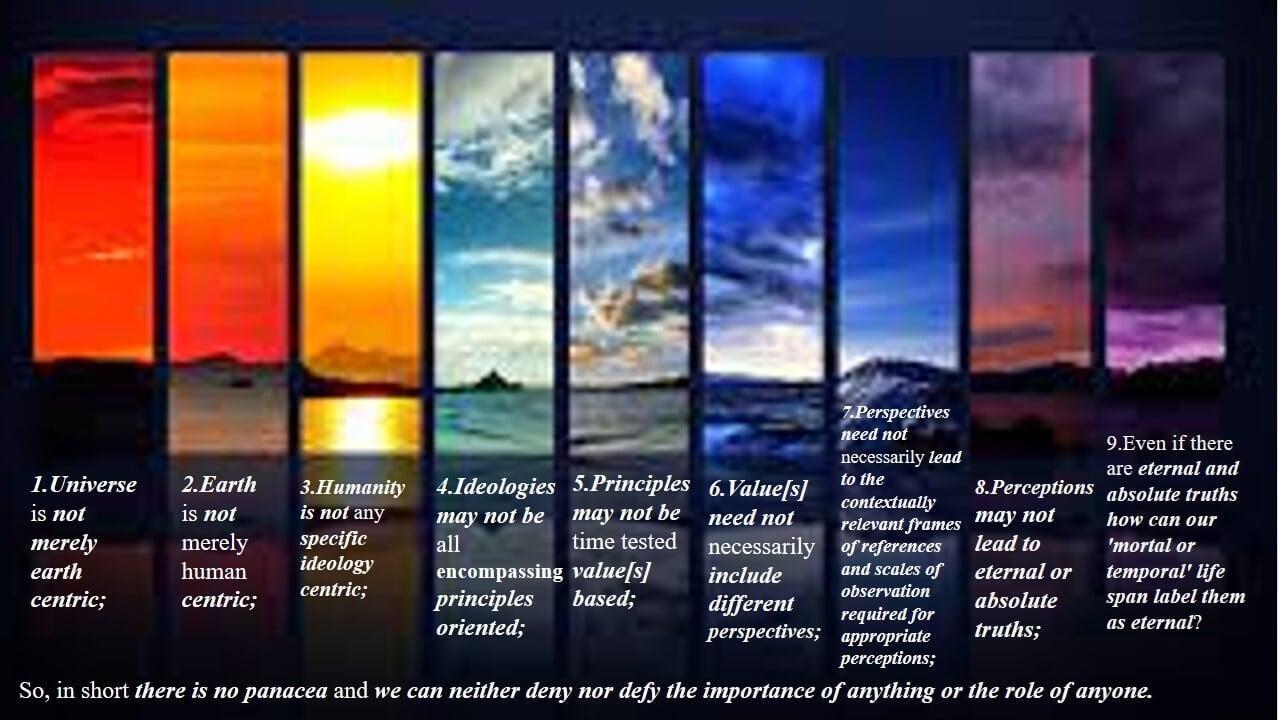
In short, I am neither trying to influence or interfere anyone’s version or perception nor even attempting to defy or to deny the importance or impact of any aspect of the great story of Mahabharata. Just a mere thought of sharing my limited attempts to grasp in a way I could and share in a way which I feel may be of interest to some.
Wherever possible I have attempted to elucidate using two SWOTs. One SWOTanalysis unique to each character or plot or event in the story and one the usual corporate SWOT.
After all the great story of Mahabharata offers a few broad SWOTs
Situational | Sensible | Serious | Sublime to the silly |
Wisdom | Wise | Works | Worthy to the worthless |
Operational | Offers | Offering | Obliging to the outrageously despicable |
Tactics | To help | Trustworthiness | Truthfulness to the trickery |